Creating Your Own Aquascape Paradise: Beginner Steps for Design, Planting, and Easy Maintenance
Aquascaping blends layout, plants, and water care into a living centerpiece. With a simple plan and a steady routine, even a first planted tank can look polished and stay healthy. The key is balancing a few fundamentals—light, nutrients, water movement, and patience—while choosing a layout and plants that match the time you can realistically spend each week. For more guidance, see A guide to aquascaping the planted aquarium.
What an aquascape needs to thrive
Before buying plants or stacking rocks, set yourself up for stability. Most early problems (algae, melt, cloudy water, stressed fish) trace back to rushing, inconsistent lighting, or a tank placed where maintenance becomes a hassle. For further reading, see Nature Aquarium Basics: A Step-by-Step Guide for Setting up Your ….
- A stable tank size and placement: Put the tank on a level surface, keep it away from direct sunlight, and leave enough room to easily do water changes.
- Balanced fundamentals: Light + nutrients + (optional) CO2 + consistent maintenance work together. Changing one without the others often triggers algae.
- A plan for livestock: Choose fish and shrimp that match your tank size and your plant density, and avoid species that uproot or bulldoze plants.
- Patience for cycling and establishment: Let beneficial bacteria and plant roots develop before heavy stocking.
Beginner-friendly gear and materials
You don’t need a showroom setup to get a great result. Aim for reliable basics, then upgrade only when you know what your plants are asking for.
- Tank: A 10–20 gallon aquarium is forgiving; very small nano tanks can swing faster in temperature and water parameters.
- Filter: Sponge filters are simple and shrimp-safe; hang-on-back and canister filters offer clearer water and better flow control.
- Lighting: Start moderate. Use a timer for consistency and begin at 6–8 hours per day.
- Substrate: Nutrient-rich aquasoil simplifies planted growth, or use inert gravel/sand with root tabs for heavy root feeders.
- Hardscape: Rocks and driftwood form the structure. Use aquarium-safe materials and avoid unknown stones that can alter hardness.
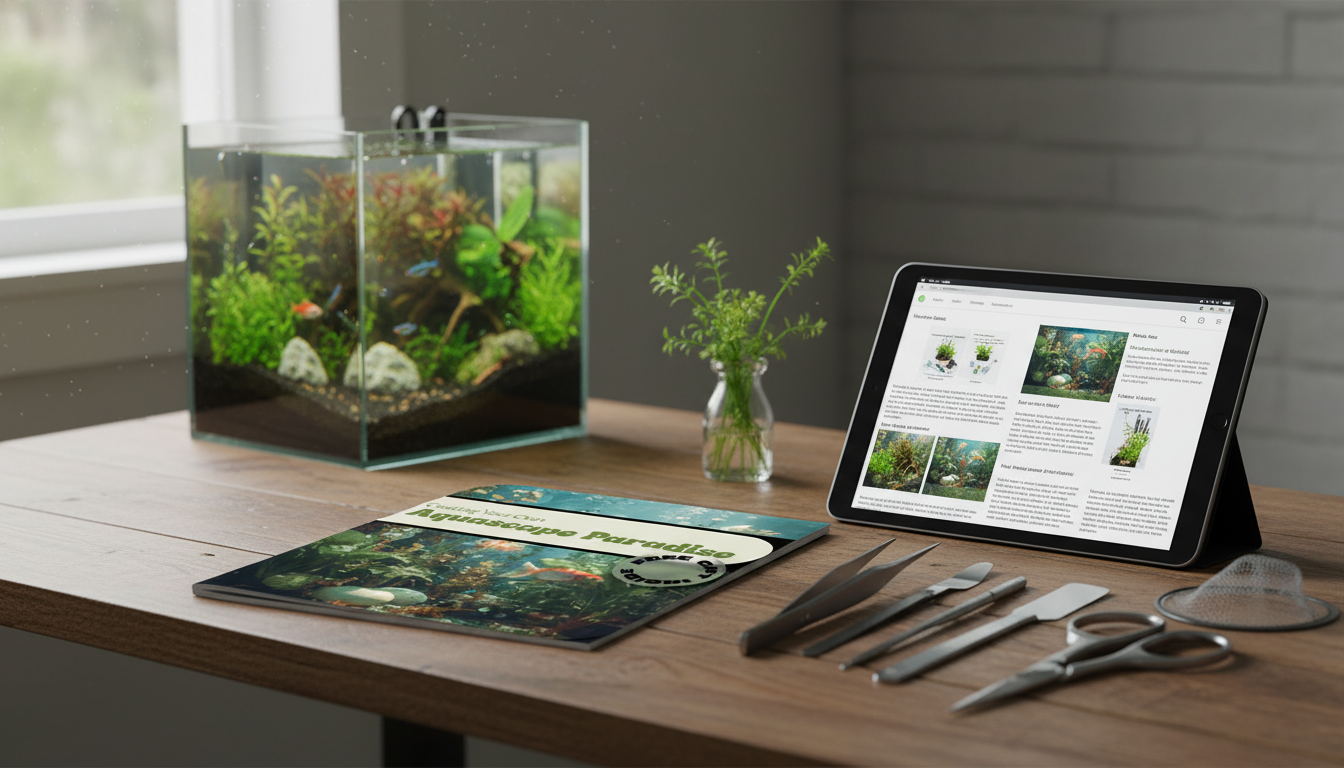
- Tools: Planting tweezers, scissors, an algae scraper, siphon, bucket, and water conditioner make weekly care faster.
- Fertilization: An all-in-one liquid fertilizer works well for beginners; add root tabs under swords, crypts, and other root feeders.
- CO2 (optional): Skip at first with low-tech plants, then add CO2 later if you want demanding carpets or faster, denser growth.
Design basics that make layouts look natural
Good aquascapes look “effortless,” but the illusion usually comes from a few repeatable rules: one main focal point, depth, and restraint.
Simple layout options and what they’re best for
| Layout |
Look |
Difficulty |
Notes for beginners |
| Island |
Central mound with open edges |
Easy |
Great for small tanks; easy to prune around the edges |
| Triangle |
High on one side, slopes down |
Easy |
Naturally creates depth; pairs well with driftwood |
| Valley/Path |
Two sides with a central path |
Medium |
Needs careful hardscape placement to keep the path clean |
| Iwagumi |
Rock-focused minimalism |
Medium–Hard |
Often needs higher light/CO2 to keep carpets healthy |
Step-by-step setup: from empty tank to planted scape
Cycling and stocking without stressing plants or fish
- Cycle before adding most fish: Track ammonia, nitrite, and nitrate while the tank matures. A clear explanation of the process is available at Aquatic Community’s nitrogen cycle overview.
- Add livestock gradually: Once parameters are safe, start with a small, hardy clean-up crew and build slowly.
- Avoid overfeeding: Excess food becomes algae fuel fast in a new aquascape.
- Quarantine when possible: It reduces the odds of pest snails and disease entering your display tank.
Easy maintenance routine that prevents algae
- Weekly water changes: 30–50% is common for new planted tanks; adjust as the tank stabilizes.
- Prune early and often: Remove melting leaves, trim stems, and replant tops to thicken growth.
- Clean with restraint: Lightly vacuum open areas, but avoid deep digging in planted zones.
- Filter care: Rinse media in removed tank water and avoid replacing all media at once.
- Light discipline: If algae appears, reduce duration or intensity before increasing fertilizer.
- Nutrient balance: Dose consistently and watch for deficiencies. For plant growth profiles and care notes, see Tropica’s plant database. For deeper filtration and water quality reading, visit American Aquarium Products.
Common beginner pitfalls and quick fixes
Digital guide for a guided, repeatable process
FAQ
How long does it take for a new aquascape to look established?
Expect it to look “freshly planted” on day one, show rooting and new growth in about 2–4 weeks, and look noticeably fuller around weeks 6–12. Regular trimming and replanting cuttings speeds up bushy growth, while cycling pace influences how quickly you can add fish.
Do beginners need CO2 for a planted aquascape?
No—many low-tech plants thrive without CO2 when light is moderate and fertilization is consistent. CO2 becomes most helpful for carpets and faster growth, but it also raises the need for stable dosing, tighter maintenance, and careful light control.
What’s the simplest way to reduce algae in the first month?
Keep the photoperiod short (around 6 hours), do consistent weekly water changes, feed lightly, and remove visible algae by hand. Start with a strong plant mass and dose fertilizer steadily rather than overcorrecting day to day.
Recommended for you












Leave a comment