Learn Smarter, Not Harder: Strategies That Make Knowledge Stick
Better learning is less about grinding longer and more about working with how memory actually strengthens: spaced practice, active recall, clear goals, and fast feedback. The payoff is durable retention you can use weeks from now—not just a temporary sense of “I’ve seen this before.” Below are practical, repeatable methods to study and skill-build with less wasted time, whether you’re prepping for exams, training for work, or learning for life.
What “Smarter Learning” Actually Looks Like
Smarter learning prioritizes what can be recalled, explained, and applied later—not what feels fluent in the moment. The difference shows up when you close the book and try to produce the idea from memory.
- Aim for durable retention (weeks/months), not short-term familiarity (minutes/hours).
- Retrieve from memory instead of leaning on re-reading, highlighting, or passively watching.
- Use smaller sessions over time so forgetting becomes a signal to strengthen recall, not a surprise.
- Track progress with simple metrics: what you can recall, explain clearly, and use in new contexts.
Research on retrieval practice consistently finds that testing yourself (even informally) outperforms many “study-only” approaches for long-term learning. See the widely cited study on the power of retrieval practice and the review of effective techniques in Psychological Science in the Public Interest.
The Core Loop: Retrieve, Check, Space, Mix
If there’s one system to build around, it’s this four-step loop. It’s simple enough to run daily, and strong enough to support complex subjects.
- Retrieve: answer questions or write what’s remembered before looking at notes.
- Check: compare to the source and correct gaps immediately to avoid reinforcing errors.
- Space: schedule quick reviews across days to keep memory “alive.”
- Mix: interleave related topics (or problem types) to improve discrimination and transfer.
Common Study Methods and How They Affect Retention
| Method |
What it feels like |
What it builds |
Better alternative |
| Re-reading notes |
Comfortable and fast |
Familiarity, not recall |
Free recall + targeted review |
| Highlighting |
Productive-looking |
Recognition, not understanding |
Explain-in-your-own-words summaries |
| Cramming |
Urgent and intense |
Short-lived performance |
Spaced sessions + practice tests |
| Practice tests |
Challenging |
Retrieval strength and diagnosis |
Keep, then add spacing and mixing |
| Teaching/explaining |
Effortful but clarifying |
Conceptual understanding |
Teach + self-quiz for precision |
Active Recall Without Burnout
Active recall doesn’t have to mean marathon practice tests. The key is frictionless prompts, fast feedback, and a bias toward fixing the weakest links.
- Start with low-friction prompts: “List the 5 key ideas,” “Define the term,” “Draw the diagram from memory.”
- Use two-pass questioning: easy questions first, then deeper application questions.
- Keep feedback tight: check answers quickly; spend time fixing weak points, not rewriting everything.
- Turn notes into questions: headings become prompts; bullet points become Q/A cards.
A quick structure that works for almost anything: (1) 3 minutes closed-book recall, (2) 2 minutes checking and correcting, (3) 1 minute tagging what needs another rep soon. Repeat with a fresh prompt set.
Spacing Plans That Fit Real Schedules
Spacing works because forgetting is part of learning—each successful retrieval after a gap strengthens the pathway. The goal is to review right before you’d lose it, not right after you’ve seen it.
- Use short sessions (10–25 minutes) and stop before fatigue reduces accuracy.
- A simple cadence: same-day quick review, next-day recall, then 3 days later, then weekly.
- Adjust spacing by accuracy: increase spacing as accuracy rises; shorten spacing when accuracy drops.
- Attach reviews to routines: commute audio recall, lunch-break flash prompts, end-of-day shutdown quiz.
One practical rule: if you’re getting 80–90% of prompts correct without peeking, widen the gap. If you’re below ~60%, tighten the gap and reduce the prompt set until it’s stable again.
Interleaving: The Fastest Way to Get Better at Applying Knowledge
Make Learning Stick with Better Notes (Not More Notes)
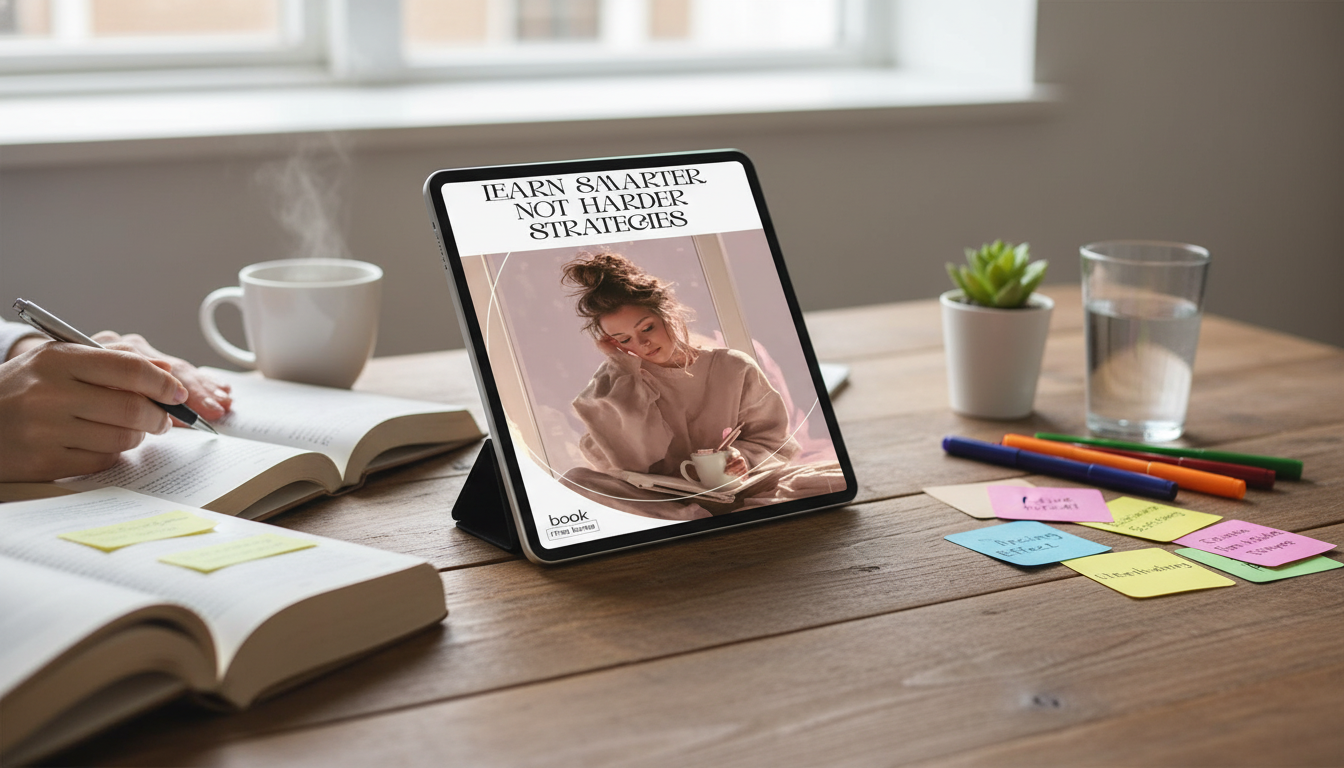
If you want a repeatable template that turns any topic into prompts, spacing cycles, and quick self-checks, the Learn Smarter, Not Harder Strategies eBook (digital download) is designed to be opened during real study sessions—not filed away and forgotten.
Avoid the Traps: Why Some Study Habits Feel Good but Fail Later
A reliable checkpoint: if progress isn’t measured by what you can produce without help, it’s easy to drift into busywork. For a quick refresher on the science behind durable learning, Make It Stick provides a helpful overview.
A 7-Day Study Smarter Starter Plan
For a ready-to-use example topic (with built-in comparisons and decision prompts), the Hybrid vs Electric Made Simple (digital guide) can double as practice material: turn each section heading into a question, then run the retrieve-check-space-mix loop until you can explain the tradeoffs without looking.
Digital Guide for Building a Smarter Learning System
FAQ
How much time should a spaced study plan take each day?
For maintenance, 10–30 minutes a day is often enough if you’re doing real retrieval and spacing. When learning brand-new material, add time in short blocks (like 2–4 sessions of 15–25 minutes) and adjust based on quiz accuracy: higher accuracy allows longer gaps, while lower accuracy needs tighter spacing.
What’s the simplest active recall method to start with?
Do 3–5 minutes of closed-book free recall: write everything you remember, then immediately check your notes and correct what’s missing or wrong. Next, turn a handful of headings into questions and reuse that small prompt set over several days.
Does highlighting ever help?
Highlighting can help you navigate a page and mark key definitions, but it doesn’t build retrieval by itself. Use highlights as cues to create recall questions, then follow up with self-quizzing or practice tests to make the knowledge stick.
Recommended for you













Leave a comment